Basement Waterproofing Red Flags Found During Home Inspections

A basement does not need to be finished to tell you a lot about a house. In fact, unfinished basements are often more honest. Drywall, flooring, and fresh paint can hide problems upstairs, but below grade, the clues tend to linger. Staining on the slab, a rust line on a water heater, white mineral deposits along a wall, a dehumidifier running full time in a corner, these details matter. During a home inspection, they often point to a water management problem that someone has treated cosmetically rather than correctly.
That distinction matters because basement moisture is rarely just about a damp smell. It can affect air quality throughout the home, shorten the life of finishes and mechanical systems, damage stored belongings, and create ongoing repair costs that far exceed what buyers expect. A basement can look acceptable during a dry week and still become a problem every spring, during heavy summer storms, or after a snowmelt. Basement Waterproofing is often discussed like a single product or service, but in practice it is a mix of exterior grading, drainage control, foundation condition, interior water management, and humidity control. A proper inspection looks at how all of those pieces work together.
Over the years, the most expensive basement issues I have seen were not always the most dramatic at first glance. A small crack hidden behind shelving can matter more than a large but stable shrinkage crack. A clean wall with fresh masonry paint can be more concerning than an old stain that has stayed unchanged for years. The key is reading the story the house is telling, and noticing where the details do not add up.
What inspectors are really looking for
A good home inspection is not a flood test. Inspectors are not digging up footings, removing finished wall systems, or waiting through a thunderstorm. They are observing conditions, looking for evidence of past or present moisture intrusion, and connecting visible symptoms to likely causes. That means the basement is never evaluated in isolation. Roof drainage, lot slope, gutter discharge, foundation exposure, hardscape pitch, downspout extensions, window wells, and nearby retaining walls all influence what happens underground.
One common mistake buyers make is focusing only on active water. If they do not see puddles on the day of the inspection, they assume the space is fine. In reality, many basements are dry at the exact moment you walk through them. The warning signs are often indirect. Water leaves patterns. Moisture changes materials. People also adapt to recurring problems in predictable ways. They run a dehumidifier constantly. They keep belongings on pallets. They avoid carpeting one corner. They place a fan near a wall. They install a sump pump but cannot explain when it was last serviced. Those habits are often more revealing than any seller disclosure.
The red flags that deserve a closer look
Some warning signs are obvious, others are subtle. These are the conditions that most often justify more questions, better documentation, or a follow-up by a waterproofing or foundation specialist.
- Efflorescence, flaking paint, or chalky white deposits on foundation walls
- Horizontal cracking, stair-step cracking in masonry, or visible wall bowing
- Fresh paint or paneling on basement walls with no clear reason for recent cosmetic work
- Persistent musty odor, high humidity, or visible mold-like growth near baseboards and stored items
- A sump pump, trench drain, or interior drainage system with unclear age, maintenance history, or discharge route
That list is only a starting point. The real work is interpreting each sign in context.
Efflorescence is not just a cosmetic nuisance
Efflorescence looks harmless if you have never dealt with basement water. It is the white, powdery residue left behind when water moves through masonry or concrete and evaporates at the surface, leaving mineral salts behind. It does not always mean liquid water is entering in large amounts, but it does prove that moisture has migrated through the material.
In older homes with masonry foundations, especially stone or block, some level of moisture movement is common. That does not automatically mean the foundation is failing. What matters is how widespread it is, whether it is active, and whether it is tied to drainage conditions outside. If you see efflorescence concentrated below a window well, near a downspout corner, or along one exterior wall where the grade slopes toward the house, the likely culprit may be manageable surface water. If the whole wall shows repeated moisture patterns, the fix may be broader and more expensive.
One of the more misleading situations is when the wall has been freshly painted with waterproofing paint. These coatings are popular because they make a basement look clean. They can also trap moisture in the wall and start peeling if the actual water pressure behind the wall is not addressed. During inspections, bubbling paint or neat rectangular patches of fresh coating often raise more concern than old staining. A seller may have improved the appearance without solving the cause.
Cracks are common, but their shape and location matter
Nearly every concrete basement develops some cracking over time. The trick is telling ordinary shrinkage from movement that deserves structural attention. Vertical hairline cracks in poured concrete are common. Many remain stable for years and can often be managed if they leak. Horizontal cracks are more serious. In block foundations, horizontal separation or inward displacement can point to lateral soil pressure. In poured walls, a long horizontal crack at mid-height can indicate bowing. Stair-step cracks in block or brick deserve close attention too, especially if they are wide, recently patched, or paired with displacement.
Width alone is not the whole story. A narrow crack with signs of repeated moisture entry may be more urgent than a wider but old and inactive crack. Inspectors look for offset edges, patching, staining, rust bleed from reinforcement, and changes in plane. They also look beyond the wall itself. Sticky windows https://zionpqhs114.northvaledigest.com/posts/the-connection-between-gutters-and-basement-waterproofing above, sloped floors, drywall cracks upstairs, or doors that suddenly rub can support the case for movement.
I once walked a basement where the owner proudly pointed out that all the cracks had been repaired. The repairs were neat, and several had epoxy ports still visible. The concern was not that the cracks existed, but that one wall also had fresh braces installed and a slight inward curve that was easiest to see by shining a light across the surface. The wall was not in immediate danger of collapse, but it was moving enough that the crack repair was only one chapter of the story. Basement Waterproofing and structural stabilization are related, but they are not the same service. Buyers need to know which problem they are actually facing.
Smells tell the truth when finishes do not
A basement smell is one of the most useful clues in a house, even though it is hard to quantify. A clean, cool basement has a distinct feel. A damp basement has another. The musty odor associated with repeated moisture exposure tends to cling to cardboard, fabric, wood shelving, and the lower edges of drywall. Even when no water is visible, that odor suggests chronic humidity or past intrusion.
Finished basements can make this harder to read. Carpet, vinyl plank flooring, insulated wall systems, and decorative trim can all conceal small seasonal leaks. When moisture gets behind finishes, the signs may show up indirectly. Baseboards swell. Metal fasteners rust. LVP edges curl slightly. Doors to storage rooms feel sticky. Paint blisters at lower corners. If there is a utility closet behind the finished area, always check it. The unfinished mechanical section usually tells the story more honestly than the family room.
High humidity by itself is not proof of leakage. Some basements are simply cool and poorly ventilated in humid climates. But if the relative humidity is high enough that surfaces feel clammy, and there is no effective dehumidification strategy, the space is at risk whether bulk water is entering or not. Basement Waterproofing is often thought of as keeping rainwater out, but many homeowners overlook the humidity side. Mold growth, odor, and deterioration can happen even without visible seepage.
Sump pumps can be reassuring, or they can be a warning
A sump pump is not automatically a defect. In many regions, it is a sensible part of the basement drainage system. The question is why it is there, how well the system is designed, and whether it is being maintained. During inspections, the basin, cover, power supply, check valve, discharge line, and termination point all deserve attention.
If the discharge line dumps too close to the foundation, the system may be cycling the same water back into the soil beside the house. If the basin is open, the basement may be exposed to moisture and soil gases. If the pump is old, noisy, or missing a battery backup in a home that depends on it heavily, the owner may be one outage away from a flood. I have seen beautifully finished basements protected by a single aging pump plugged into a standard outlet with no alarm and no backup. That is not peace of mind, it is wishful thinking.
Interior drain tile or perimeter channel systems deserve the same scrutiny. They can be effective, especially where exterior excavation is impractical, but they do not make groundwater disappear. They manage it after it reaches the foundation perimeter. That can be a practical solution, but buyers should understand the trade-off. An interior system often means the basement stays usable by collecting water before it rises onto the floor. It does not necessarily mean the wall stays dry in the same way a full exterior waterproofing system might.
Exterior clues often predict basement trouble better than the basement itself
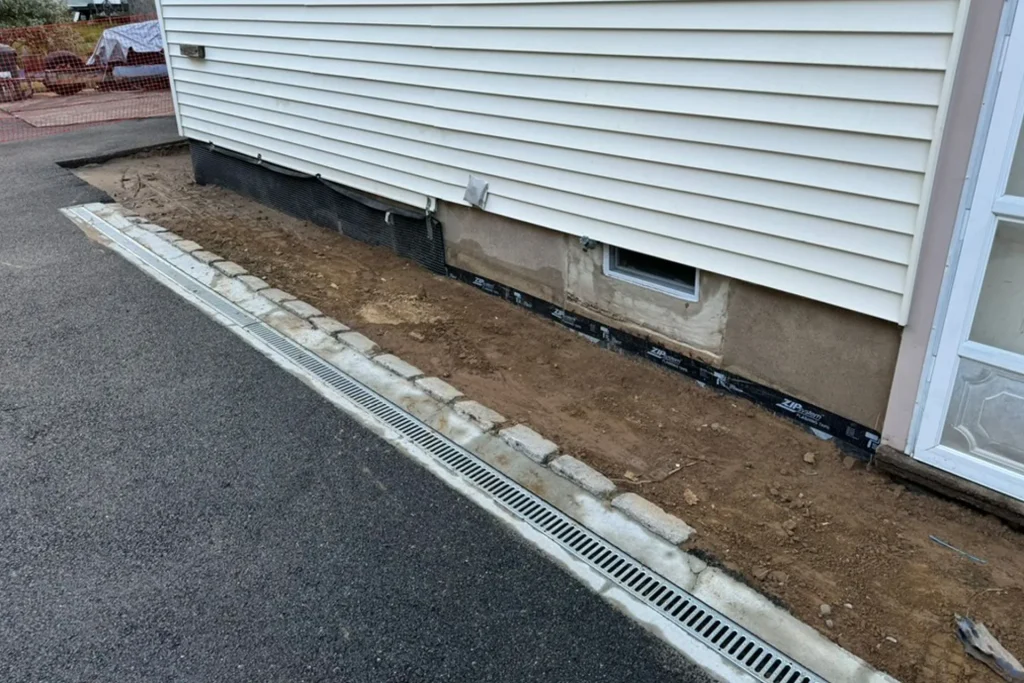
The most revealing basement inspection may begin outside. Water should move away from the house quickly. When it does not, the basement usually pays for it. Poor grading is one of the most common and most fixable contributors to moisture. A shallow depression near the foundation, a walkway pitched toward the wall, or mulch piled high against siding can direct water exactly where it should not go.
Downspouts are another repeat offender. Short splash blocks look better than nothing, but in many cases they are nowhere near enough. On homes with clay soil or tight lot lines, roof runoff discharged near the house can saturate the soil and increase hydrostatic pressure against basement walls. During a strong storm, one roof plane can dump an astonishing amount of water. Even a modest rain event on a large roof can send hundreds of gallons into the drainage path around the foundation. That does not mean every house needs an elaborate underground drain system, but it does mean the basics have to work.
Window wells deserve special attention. If they fill with leaves, lack drainage, or sit below grade in a low spot, they can become direct entry points. The signs may show up inside as staining below a basement window, rot at a wood frame, or dampness concentrated at one end of the wall. Sometimes the repair is straightforward, such as clearing and regrading. Sometimes the well drain is clogged or the original installation was poor. Again, context matters.
Cosmetic cover-ups during the selling process
Home inspections often happen after a property has been cleaned, staged, and touched up. That is normal. It also means buyers should be alert to basement improvements that seem designed to distract rather than solve. New shelving can hide wall surfaces. Area rugs can cover staining. A dehumidifier may be emptied right before the showing. Boxes may be lined neatly along the perimeter where water tends to appear. None of these things prove bad faith, but they should prompt closer observation.
Fresh paint near the bottom two or three feet of a basement wall is a classic example. So is new trim in a space where the flooring at the perimeter shows subtle discoloration. Recently replaced sections of drywall are not necessarily suspicious, especially after a known plumbing leak, but the explanation should make sense. If the seller says a wall was opened for electrical work, yet the lower studs show water staining and the insulation looks newer than the rest, more questions are fair.
Inspectors also notice what is absent. A basement with no visible stored items against the walls, in a house otherwise full of possessions, can be telling. Homeowners who have experienced seepage often learn not to keep cardboard, paper goods, or furniture legs directly on the slab.
Not all water problems require full excavation
One reason basement issues create anxiety is that people imagine the most invasive repair first. Sometimes that is justified. Exterior excavation to footing depth, membrane application, drainage board, and footing drain replacement can be the right answer for recurring seepage or hydrostatic pressure, especially when foundation walls are deteriorating or exterior drainage was never installed correctly. But a surprising number of basements improve dramatically with less drastic corrections.
A house that takes in water at one corner because a downspout ends three feet from the wall may not need a full waterproofing overhaul. It may need a proper extension, regrading, and a corrected window well. A basement with elevated humidity and condensation on ducts may need air sealing, insulation changes, and dehumidification rather than foundation work. The danger lies in oversimplifying in either direction. Sellers sometimes minimize serious issues as “just a little moisture,” while contractors sometimes recommend expensive systems before simpler contributing factors are fixed.
This is where experienced judgment matters. Basement Waterproofing should be matched to the failure pattern, not sold as a one-size-fits-all package.
Questions buyers should ask before they get comfortable
A home inspection can identify red flags, but it rarely answers every question on its own. Buyers should press for specifics, especially when the basement has evidence of previous work.
- When did water first appear, and under what conditions does it happen?
- What repairs or waterproofing measures have been installed, and are receipts or warranties available?
- Has the sump pump ever failed, and where exactly does the discharge terminate?
- Were any cracks evaluated by an engineer or repaired by a contractor, and what method was used?
- Have basement finishes, flooring, or lower drywall sections been replaced, and if so, why?
The quality of the answers matters almost as much as the content. Vague replies like “the basement has always been dry since we did some work” are less helpful than “water entered twice during heavy spring storms before we extended the downspouts and installed a new well drain in 2021.” Specifics suggest the owner understood the problem and addressed it intentionally.
Older homes, newer homes, different failure patterns
Age changes the way moisture problems show up. Older homes with stone, brick, or block foundations were often built to manage some moisture movement rather than exclude all of it. They may perform reasonably well for decades if water is allowed to drain properly outside and the interior is not sealed in ways that trap vapor. Problems arise when modern finishes are applied without understanding the wall assembly. A stone foundation that handled occasional dampness for a century may become a mold problem after someone adds fiberglass batts and drywall directly against it.
Newer homes are not immune. In fact, buyers are often more shocked when a fifteen-year-old house has basement water because they assume newer construction means trouble-free construction. Yet poor grading after settlement, clogged footing drains, inadequately compacted backfill, builder-grade sump pumps, and rushed window well installation can all create early problems. In newer poured-concrete basements, shrinkage cracks are common. The key is whether they remain hairline and stable or become water paths.
Regional soil conditions matter too. Expansive clay, freeze-thaw cycles, and high seasonal water tables all influence basement behavior. That is why identical symptoms can lead to different recommendations in different markets. A damp corner in a dry-climate basement may have one explanation. The same symptom in a wet region with heavy clay and spring saturation may point to a more systemic problem.
What a prudent next step looks like
When inspection findings point to meaningful basement moisture concerns, the smartest next move is usually targeted follow-up, not panic. That might mean a waterproofing contractor, a foundation specialist, or in some cases a structural engineer. The goal is to define the problem clearly enough that repair options can be compared on scope, effectiveness, disruption, and cost.
Buyers should resist two extremes. The first is dismissing the issue because the basement looked “mostly fine.” The second is assuming the worst and walking away from an otherwise solid property without understanding the actual fix. I have seen deals fall apart over moisture issues that could have been corrected for a few thousand dollars, and I have seen buyers inherit major drainage failures because no one pushed past the cosmetic finish layer.
A sound evaluation usually separates three questions. First, is there active or recurring water intrusion? Second, is there structural movement or only moisture management trouble? Third, what combination of exterior drainage correction, crack repair, interior drainage, and humidity control makes sense for this house? When those questions are answered honestly, the path forward gets much clearer.
The basement does not have to be perfect to be acceptable. It does have to be understood. That is the difference between a manageable maintenance issue and an expensive surprise. A careful inspection, with a sharp eye for waterproofing red flags, gives buyers the chance to make that distinction before the keys change hands.
ARD Waterproofing
98 Smull Ave, West Caldwell, NJ 07006, United States
+1 917-691-8411
FAQ About Basement Waterproofing
Can you 100% Waterproof a Basement in West Caldwell?
A properly designed system can substantially reduce basement water intrusion, but no method can promise protection against every flood, equipment failure, or future change in site conditions. The first step is identifying whether moisture comes from surface runoff, groundwater, plumbing, or condensation. Solutions may include grading and gutter improvements, drainage, foundation repairs, and a sump system. Review the specific coverage and exclusions of any written warranty.
How much does it cost to professionally waterproof a basement in NJ?
There is no single price that fits every basement. Cost depends on the cause of the leak, the area needing work, access, excavation requirements, drainage design, sump equipment, and restoration of disturbed finishes or landscaping. Request an on-site assessment and an itemized written estimate that explains the scope, exclusions, and maintenance requirements before comparing proposals.
How long does foundation waterproofing last in West Caldwell, NJ?
Service life varies with the waterproofing materials, installation quality, soil and water conditions, and maintenance. Drainage components and pumps may require servicing or replacement even when other parts of the system remain functional. Keep gutters, drainage outlets, and sump equipment maintained, and have recurring leaks or changes in foundation condition assessed. Ask for product-specific expectations and written warranty terms rather than relying on one lifespan for the entire system.